Search has three layers
Your knowledge has to be publicly indexed and cleanly structured
If your community's best solutions are buried in a Discord server or locked in Slack, AI can't find or cite them. To be visible today, your knowledge has to be publicly indexed and cleanly structured.
Discourse turns every community topic into a durable search asset: searchable through Google, retrievable by AI assistants, and surfaced through Discourse's own built-in search. Get the answer right, structure it well, keep it updated and fresh, and AI search agents will keep using that answer indefinitely.
Classic Google
Each Discourse topic gets its own URL, clean HTML semantics, and crawlable metadata, so Google can index every topic.
AI assistants
ChatGPT, Claude, and Perplexity answer from the public web. Public Discourse forums are part of it.
Discourse's own search
Semantic search and Ask AI find the right topic inside your community, even when the question is phrased differently.
Quality controls
Turn community answers into citation-ready knowledge
Searchability only matters if the content is accurate. When an AI cites a wrong or outdated answer, it does more damage than no answer at all. Discourse includes quality controls that maintain a high signal.
The goal is a body of community knowledge you'd be comfortable having an AI cite to a prospective customer. Discourse's moderation tools make that possible.
Trust levels
Discourse's trust system gates permissions based on participation history. New accounts can't immediately post links, move topics, or take moderator actions. Users earn access through good-faith engagement, which keeps spam and low-quality posts out of your indexed content.
Moderation tools
Staff can hide, split, merge, or lock topics. Wiki posts let trusted members maintain a single authoritative answer rather than scattering corrections across follow-up replies.
Solution marking
When staff or trusted members mark an answer as a solution, Discourse surfaces it at the top of the topic and structures it so search engines and LLMs can recognize the resolution. A topic with a marked solution is easier for a model to parse than one that trails off.
Translations
If your community runs in multiple languages, Discourse supports localization, and automated translation is available on every plan. Your tier sets how many languages you can run. More indexed answers in more languages make your community searchable to more people.
Built for search
Make answers searchable by humans
Each Discourse topic gets its own URL, clean HTML semantics, and crawlable metadata. On top of it, Discourse adds:
Semantic search
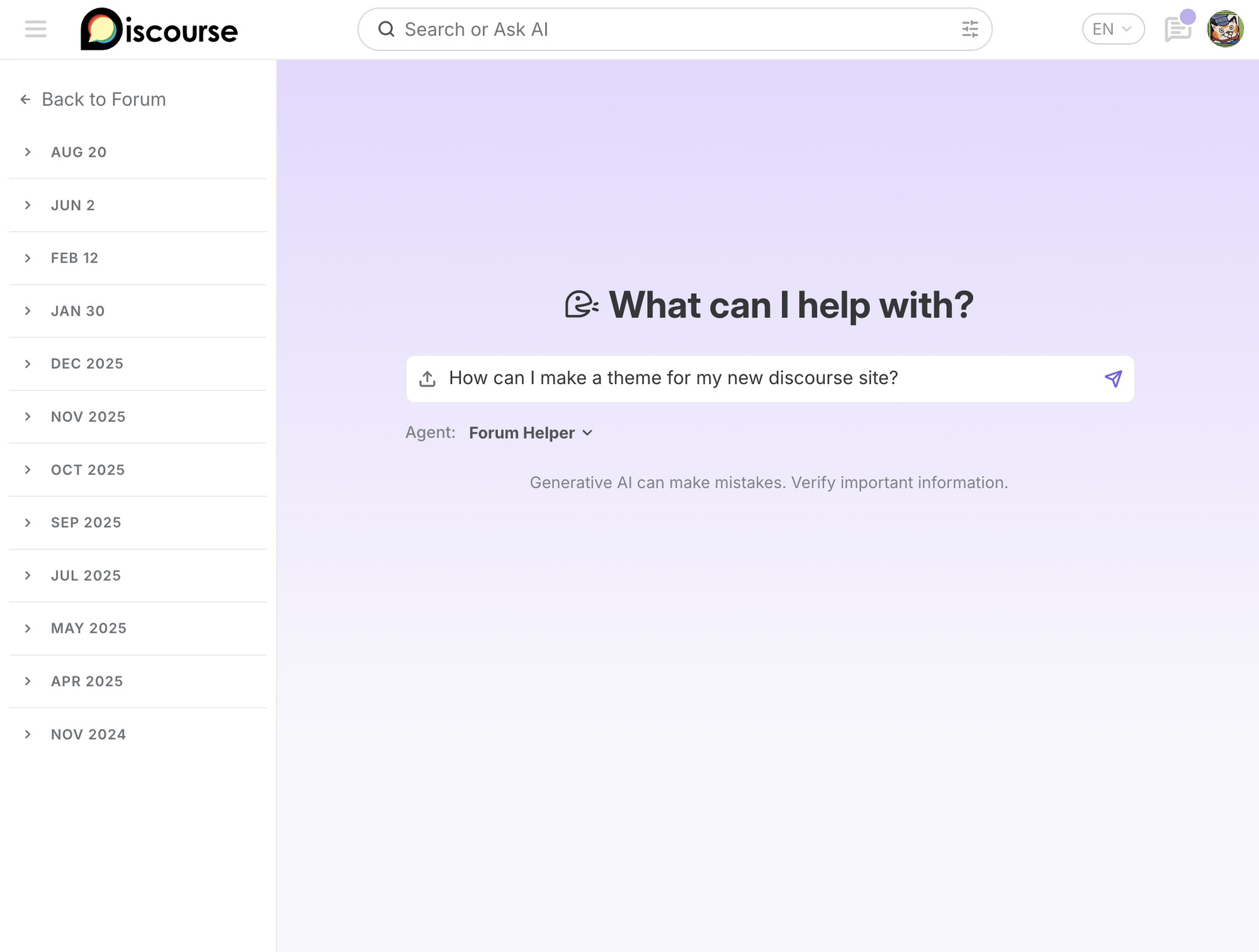
Users find the right topic even when they phrase the question differently from the person who asked it first. Ask AI goes a step further, answering the question directly from your community's content rather than handing back the right topic to read.
Conversation summaries
Discourse can generate AI-powered summaries of long topics, so readers get the answer without wading through 80 replies.
Structured data markup
Discourse outputs QAPage schema for solved topics, which signals to Google and AI crawlers what type of content this is and which reply resolves the question. Core marks up ordinary posts too, with DiscussionForumPosting, Comment, InteractionCounter, LikeAction, Person, and Organization.
AI searchability
Public Discourse forums get indexed by the crawlers that power LLM retrieval. When someone asks Perplexity or ChatGPT a product question your community answered months ago, a well-structured Discourse topic is the kind of source those models reach for.
Keep content current
Let the knowledge base stay alive
A decaying knowledge base is worse than no knowledge base. Stale answers get cited, users get wrong information, and people lose trust. Discourse gives you tools to keep content current without making maintenance a full-time job.
Categories and tags
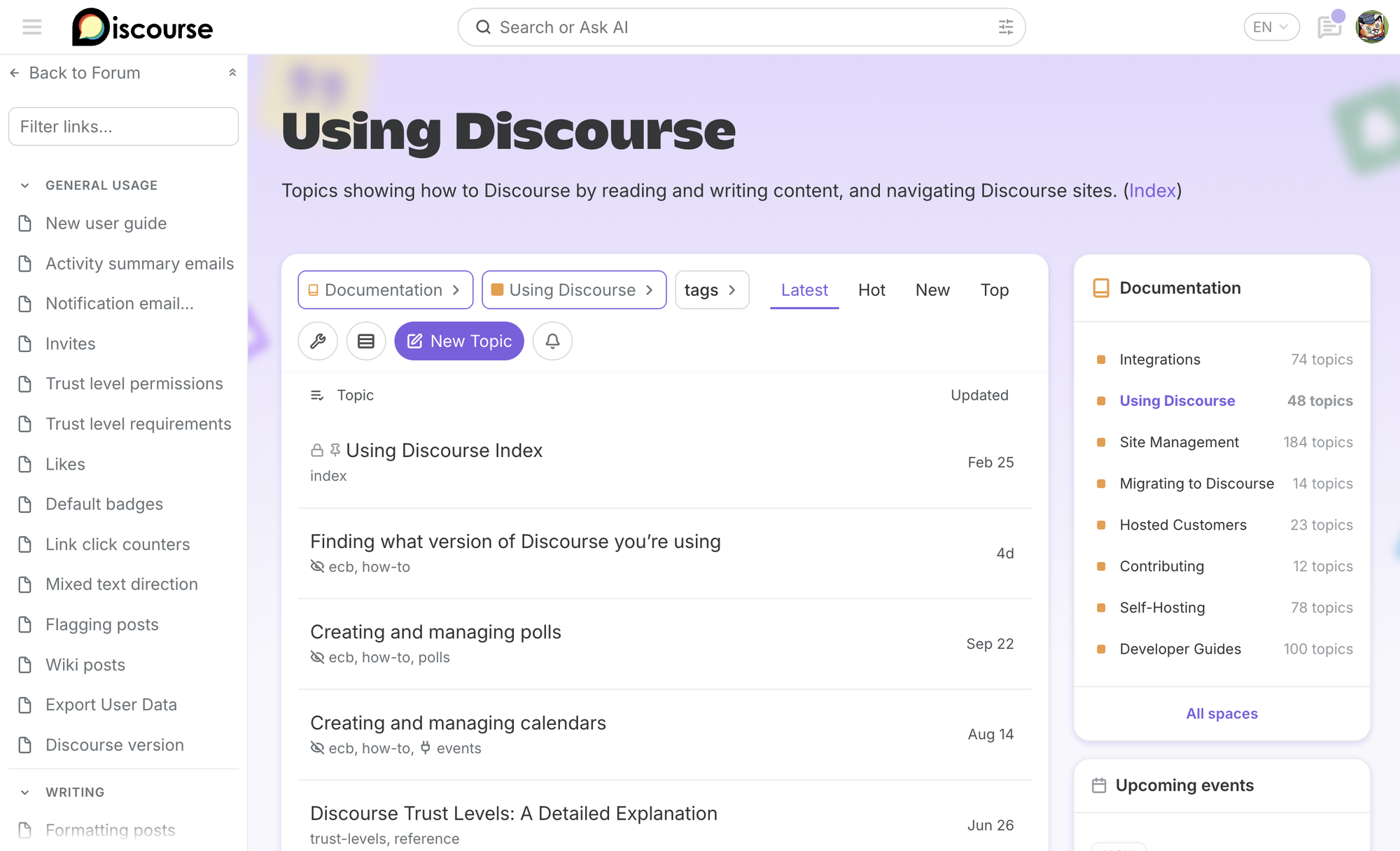
Organize topics by product area or release version to quickly audit what's outdated. A category scoped to "v2.x" is easy to sweep when v3 ships.
Workflows
Set a periodic trigger to scan your own content for gaps or outdated material and flag it for review or suggest an edit, so audits run on a schedule instead of whenever someone remembers.
Discourse Discover
Communities listed with support or documentation tags are publicly visible to users looking for active forums.
Docs promotion
Pin critical topics, create a dedicated documentation category, or use Discourse Docs, available on Business plans and above, to turn your best topics into a structured knowledge base that lives alongside the community.
Analytics
Discourse's dashboard shows you which topics drive the most traffic and what people are searching for, with drill-down reports and custom Data Explorer queries to dig deeper. Ask AI also groups the questions members put to it on a regular schedule, so you can see what people care about most and where they aren't finding answers. That data helps you decide where to write, update, or redirect.
Best practices
Habits that make LLMs love your content
Structure gets your community indexed. These habits make each answer worth citing, so the topic a model reaches for is the one that solves the problem.
Walled gardens
Why hiding your content costs you citations
Slack and Discord operate as walled gardens, completely hiding community knowledge from the open web. Because search engines can't index these internal conversations, organic discovery is impossible. Instead of finding existing answers with a simple web search, users must create accounts, join specific servers, and ask the same questions again and again.
At Discourse, we keep every chat as open as you want it to be, and make sure every search agent can tap into your knowledge, elevating your brand in the process.
No organic discovery
Search engines can't index conversations inside Slack and Discord, so the answers your community already wrote never show up in a web search or an AI assistant's reply.
No true interoperability
These platforms force reliance on proprietary clients and brittle third-party integrations.
History held hostage
Free tiers often hold historical knowledge hostage, such as Slack's 90-day message limit, and exporting chat logs is structurally messy or restricted.
A higher barrier to entry
By gating discussions behind mandatory logins and prioritizing synchronous chat, these platforms raise the barrier to entry and alienate asynchronous contributors.
Professional services
Get help with setup from the Discourse team
If you'd rather not configure everything yourself, Discourse's professional services team can help with categories, integrations, moderation, and AI features tailored to your needs. They're engineers who know the platform well.
See it in action
Browse Discourse Discover
Active forums listed by category. See how different organizations structure Discourse for support, documentation, and searchability.
Explore communitiesThe AI Search Revolution's Hidden Dependency
Why AI answers depend on a public, well-structured source of community knowledge.
Read on the blogYour Community as Your AI Knowledge Layer
How a Discourse community becomes the knowledge layer that search engines and AI assistants draw from.
Read on the blog